Steffi Feistl, Anna Gomeringer, Kristin Hinkelmann, Kathi Huber and Fenja Köchl opened Nyi Nub (M3–5) on the northwest ridge of Sharphu VI (6,076 m) in eastern Nepal. It was only the second ascent of the summit, and it closed the three-year training programme of the German Alpine Club’s women’s expedition squad.
The five reached the top on 21 October, according to the German Alpine Club (DAV), which calls the weather of those two weeks perfect. Nyi Nub climbs the northwest ridge for about 1,300 metres from the advanced base camp at 4,800 metres, with four mixed pitches on a steep step low down. The women rate the technical part M3–4 on their topo, plus an M5 variant of the crux pitch. The DAV’s own summary lists the whole line as M5, 55°. None of it came cheap. The squad had two weeks in base camp, deep snow from an exceptionally snowy summer to wade through, and a first target that turned out to be too dangerous to touch.
The name is Tibetan. Nyi nub means sunset, as a Tibetan dictionary confirms. MOUNTAIN.RU, quoting the team’s Instagram, says the women named the line after the sunset they watched from their high camp at 5,800 metres, one that left them speechless. The DAV reports do not explain the name, so the Instagram quote is the team’s word and nothing more.
Sharphu VI sits in the Ohmi Kangri Himal, west-northwest of Kangchenjunga, in Nepal’s Taplejung district. Kangchenjunga is the third-highest mountain on Earth, but the Sharphu group is another world, a handful of peaks between about 6,080 and 6,430 metres above the Nupchu and Yangma valleys that few teams ever visit. The women based themselves in the Yangma valley near the Chinese border. They got there via Kathmandu, a domestic flight to Bhadrapur, two days of jeep driving on a landslide-torn track and three days of trekking, and pitched base camp at 4,000 metres. The DAV had planned the flight for 2 October and the return for about 1 November.
The mountain has a short and slightly muddled history. A Japanese team tried the northwest ridge in autumn 2023 and turned back near 6,000 metres in front of an impassable crevasse, according to the American Alpine Journal and the Himalayan Database. The first ascent followed on 25 March 2025, when Hernán Leal of Chile with Lhakpa Chhiri Sherpa, Ngada Sherpa and Purnima Shrestha climbed the east flank. They believed they were on Sharphu IV. Nepal’s official peak list scrambles the heights and names in the group, and Explorersweb needed researcher Rodolphe Popier to show that the summit photos were of Sharphu VI. The AAJ adds that the 2025 party came out on the final section of the northwest ridge, so the very top had seen visitors before. Lacrux calls Nyi Nub the first route set on this peak on purpose.
The women’s first idea was the west face of Sharphu II (6,328 m), the white wall that fills the valley. The first known ascent of that mountain was Spencer Gray and Aivaras Sajus in October 2018, by the east face, with Samsara (1,040 m, ED2 AI5 M6). The squad found brittle rock exposed in the lower part and seracs above that kept shedding ice avalanches. One rope team still tried a snow couloir, then turned around when a snow profile and two whumpf sounds said the avalanche danger was too high. Köchl had studied the face photo almost daily during planning. “That would have been my dream, but it burst,” she said.
That left Sharphu VI. From the advanced base camp on a moraine ridge, Köchl, Hinkelmann and Huber went first and reached a steep step at about 5,300 metres. The topo said M3–4, which sounds friendly. In reality deep powder lay on bare rock, so gear was hard to place and moves hard to trust. Huber said the pitches had looked easy but were steeper than expected, with nasty granular snow and no hold on the rock beneath. Anchors were built for rappelling from the start. The next day Feistl and Gomeringer took over. Feistl cracked the last and hardest mixed pitch, then switched to vole mode, as she put it, about 200 metres of belly-deep powder. Lacrux puts the technical part at four pitches and 230 metres and the end of the work at 5,690 metres.
After a rest day the five went up together, which suited the terrain. Köchl led and belayed two women up, one of whom then belayed the last two, so the mixed belt went quickly. They crossed a previously unclimbed 5,800-metre sub-peak, reached a glacier plateau and spent a freezing night in a tent. The cold drove them out in the dark and they set off on the last two kilometres. Sun in the previous days had firmed the snow, so they sank in only to the knees. The final ridge was a knife-edge of powder, a shark fin in the team’s words, and only one or two people fitted on top. Gomeringer and Köchl went first and stamped the loose snow down, then the other three followed, hence two separate summit selfies. The team’s Instagram caption, as relayed in two reports, speaks of a summit push on 22 and 23 October. The DAV says 21 October, so the exact day deserves a footnote.
The descent was uneventful in their own tracks, with the anchors waiting. Gomeringer remembers the moment back on the moraine at last light, when expedition doctor Laura Tiefenthaler ran toward them to hug them. After a rest day Gomeringer and Hinkelmann started the walk out. Köchl, Feistl, Huber, Tiefenthaler and coach Dörte Pietron added an unnamed summit of about 5,800 metres, an easy glacier and snow ridge graded PD.
The Expedkader is the DAV’s training programme for young alpinists. The women’s squad of 2024 to 2026 was chosen after two selection camps, one in the Allgäu in winter and one in Mittenwald in May. About 50 women applied, 15 were invited and six made the squad. Chief coach Pietron was the only woman in the mixed squad of 2003 to 2005, later argued for a separate women’s team and led it for 16 years. She received the DAV Sportpreis in 2025. She now hands over to Raphaela Haug and Tiefenthaler, both former squad members. Haug missed the expedition for health reasons. Pietron lost her acclimatisation nights to a stomach bug, Vera Bakker had to sit out the summit push for similar reasons, and Tiefenthaler stayed in base camp too, which left the five best placed for terrain that needs belaying. The squad’s farewell evening is public, on 3 December at 7 pm at the DAV head office in Munich.
The five who stood on top are young and varied. Feistl (born 1998, Bayerland) is training to be a teacher, runs training for the mountain rescue in Weilheim and has climbed Muztagh Ata (7,549 m) and Ruby Tuesday (M6) on the Rubihorn. Gomeringer (1997, Konstanz) is an aspiring mountain guide. Hinkelmann (2003, Konstanz) is the youngest of the squad. Huber (1997, Tegernsee) works as a doctor and says she is no mixed specialist, but felt at home in this team. Köchl (2000, Tölz) prepared in Peru on Alpamayo and two other summits, and in spring she climbed the Slovene Route on the Grandes Jorasses with Gomeringer.
Few expeditions come to Sharphu VI, and two are on record before this one. The Himalayan Database had not yet added the 2026 ascent when we checked. It was not the only new line in Nepal this autumn. The French army trio of the GMHM opened Bon matin on Peak 41 in pure alpine style, and you can read about two more six-thousander lines in The Leopard of Higher Ground and Chegi on Ama Dablam.
Sources: DAV (26.11.2026), DAV (17.11.2026), DAV (02.10.2026), DAV (Expedkader 2024–2026), DAV (Steffi Feistl), Lacrux (26.11.2026), Explorersweb (24.11.2026), Gripped (25.11.2026), MOUNTAIN.RU (22.11.2026), AAJ (Sharphu VI 2025), AAJ (Sharphu VI 2023), AAJ (Sharphu II 2018), Himalayan Database (Sharphu VI), Explorersweb (01.04.2025), Rangjung Yeshe Wiki (nyi nub).
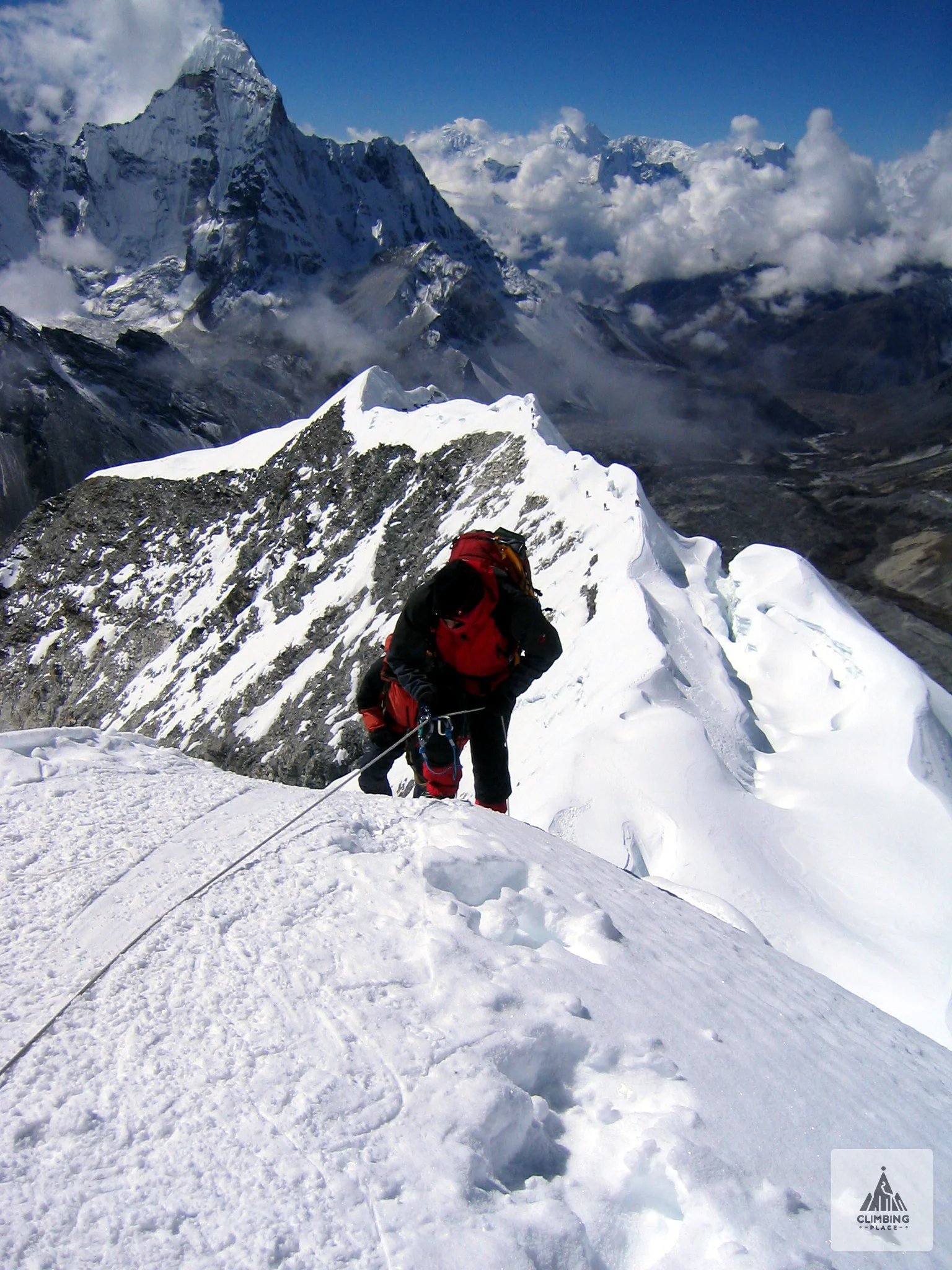
Cover: a climber on the summit ridge of Island Peak (Imja Tse, 6,189 m) in the Khumbu region of Nepal, 2004. Illustrative, not the DAV team, not Sharphu VI and not Nyi Nub. Not cropped. Photo: Mountaineer, CC BY 3.0, via Wikimedia Commons.

Comments
No comments yet.
Sign in to like and comment.